The Green Knight’s axe
Sir Gawain and the Green KnightThe Green Knight’s axe is the weapon at the center of the poem’s beheading challenge, first wielded by Sir Gawain and later brought back against him. Its enormous scale makes the exchange of blows a spectacle, while its final, controlled descent transforms the threat of execution into a test whose outcome differs from the one Sir Gawain expects.
Form and First Appearance
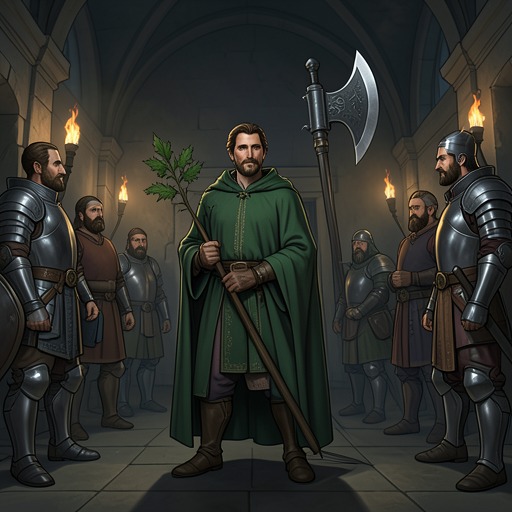
The Green Knight enters without the usual equipment of an armed knight: he carries neither armor nor shield nor spear. In one hand he holds a holly branch; in the other, an axe with an exceptionally large head, described as so immense that it strains ordinary speech to describe it. Its head measures an ell in length. Set beside the living holly, the weapon gives his entrance two sharply contrasting emblems: a green branch and a formidable instrument of violence.
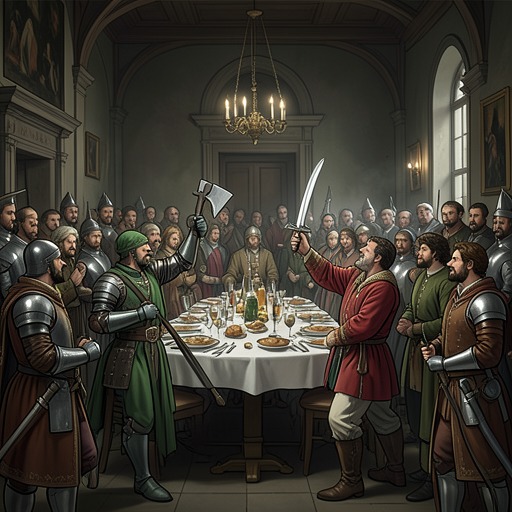
When Sir Gawain takes up the axe, he plants his front foot on the ground and raises it high before striking. The blade cuts through the Green Knight’s neck and reaches the ground; the severed head falls, rolls among the feet of those nearby, and blood springs from the body onto the green. The weapon thus makes the challenge’s apparent conclusion brutally visible, even as the Green Knight’s survival will make that conclusion provisional.
Return at the Green Chapel
At the meeting place, the weapon returns in the Green Knight’s hands. He comes out from a hollow by a crag, wheeling a newly prepared axe, and takes up the challenge that Sir Gawain’s earlier stroke appeared to have settled. The change of wielder reverses the scene’s first arrangement: the man whose neck the blade split now controls its descent toward Sir Gawain’s bare neck.
The Green Knight lifts the axe and lets it fall lightly, bringing the blade’s edge against Sir Gawain’s exposed neck without injuring him further. Its size had made the first blow look like an irreversible execution; now the weapon’s movement is exact enough to stop at the boundary between threat and harm. The axe remains dangerous, but its decisive force lies in the wielder’s restraint: the expected repetition of the beheading becomes a measured stroke.
Place in the Adventure’s Design
The axe belongs to an adventure presented as a marvel, not an ordinary contest of arms. The poem frames the episode as an extraordinary wonder associated with the youthful Arthur, who had eagerly sought tales of adventure. In that setting, the weapon turns the Green Knight’s arrival into a challenge that is at once spectacular and perilous: what begins as something to witness becomes a deed Sir Gawain must perform, then a danger he must face in return.
Its narrative importance lies in carrying that challenge across the poem’s separated encounters. The axe first makes the beheading game physically possible; when it reappears at the Green Chapel, it gives the deferred answer a material form. The instrument therefore links courtly wonder to the later test of Sir Gawain, while the contrast between its capacity to sever and the final controlled stroke makes its threat a measure of restraint as well as force.
Identity and the Return Stroke
The axe’s final appearance is followed by the disclosure that its wielder is Bertilak de Hautdesert, acting through the power of Morgan le Fay. That revelation changes the meaning of the weapon’s return: what had seemed to be a supernatural stranger’s execution is part of a test arranged through a familiar host, and the controlled stroke belongs to the same design as the earlier challenge. The axe therefore marks not only the exchange between the two men but the point at which its apparent violence is explained as a managed trial.